What Number Is Used Again and Again in the Construction and Design of Paths Metaphors

A metaphor is a effigy of voice communication that, for rhetorical effect, direct refers to one thing past mentioning another.[1] It may provide (or obscure) clarity or identify hidden similarities between 2 different ideas. Metaphors are often compared with other types of figurative language, such every bit antithesis, hyperbole, metonymy, and simile.[2] One of the about commonly cited examples of a metaphor in English language literature comes from the "All the world'southward a stage" monologue from As Yous Like It:
All the world's a phase,
And all the men and women merely players;
They accept their exits and their entrances ...
—William Shakespeare, As You Like Information technology, 2/7[3]
This quotation expresses a metaphor because the globe is not literally a stage, and most humans are non literally actors and actresses playing roles. By asserting that the earth is a stage, Shakespeare uses points of comparison betwixt the world and a phase to convey an understanding about the mechanics of the world and the behavior of the people within it.
According to the linguist Anatoly Liberman, "the apply of metaphors is relatively tardily in the mod European languages; it is, in principle, a mail service-Renaissance phenomenon".[4] In contrast, in the ancient Hebrew psalms (around grand B.C.), one finds already vivid and poetic examples of metaphor such as, "The Lord is my rock, my fortress and my deliverer; my God is my rock, in whom I take refuge, my shield and the horn of my salvation, my stronghold" and "The Lord is my shepherd, I shall not want." At the other farthermost, some contempo linguistic theories view all language in essence every bit metaphorical.[five]
The give-and-take metaphor itself is a metaphor, coming from a Greek term pregnant "transference (of ownership)". The user of a metaphor alters the reference of the discussion, "carrying" it from one semantic "realm" to another. The new pregnant of the word might be derived from an analogy between the two semantic realms, just likewise from other reasons such every bit the distortion of the semantic realm - for example in sarcasm.
Etymology [edit]
The English word metaphor derives from the 16th-century Old French give-and-take métaphore, which comes from the Latin metaphora, "carrying over", and in plough from the Greek μεταφορά (metaphorá), "transference (of ownership)",[6] from μεταφέρω (metapherō), "to carry over", "to transfer"[7] and that from μετά (meta), "behind", "along with", "beyond"[eight] + φέρω (pherō), "to conduct", "to carry".[nine]
Parts of a metaphor [edit]
The Philosophy of Rhetoric (1937) by rhetorician I. A. Richards describes a metaphor every bit having 2 parts: the tenor and the vehicle. The tenor is the bailiwick to which attributes are ascribed. The vehicle is the object whose attributes are borrowed. In the previous example, "the world" is compared to a stage, describing it with the attributes of "the stage"; "the globe" is the tenor, and "a stage" is the vehicle; "men and women" is the secondary tenor, and "players" is the secondary vehicle.
Other writers[ which? ] apply the general terms 'footing' and 'figure' to denote the tenor and the vehicle. Cerebral linguistics uses the terms 'target' and 'source', respectively.
Psychologist Julian Jaynes coined the terms 'metaphrand' and 'metaphier', plus 2 new concepts, 'paraphrand' and 'paraphier'.[10] [11] 'Metaphrand' is equivalent to the metaphor-theory terms 'tenor', 'target', and 'ground'. 'Metaphier' is equivalent to the metaphor-theory terms 'vehicle', 'figure', and 'source'. In a elementary metaphor, an obvious attribute of the metaphier exactly characterizes the metaphrand (e.g. the transport plowed the seas). With an inexact metaphor, all the same, a metaphier might have associated attributes or nuances – its paraphiers – that enrich the metaphor because they "project back" to the metaphrand, potentially creating new ideas – the paraphrands – associated thereafter with the metaphrand or even leading to a new metaphor. For instance, in the metaphor "Pat is a tornado", the metaphrand is "Pat", the metaphier is "tornado". As metaphier, "tornado" carries paraphiers such as ability, tempest and wind, counterclockwise motion, and danger, threat, devastation, etc. The metaphoric significant of "tornado" is inexact: ane might sympathize that 'Pat is powerfully subversive' through the paraphrand of physical and emotional destruction; another person might understand the metaphor as 'Pat can spin out of control'. In the latter case, the paraphier of 'spinning motion' has become the paraphrand 'psychological spin', suggesting an entirely new metaphor for emotional unpredictability, a possibly apt description for a man existence hardly applicable to a tornado. Based on his assay, Jaynes claims that metaphors non simply heighten description, but "increase enormously our powers of perception...and our understanding of [the world], and literally create new objects".[10] : 50
Equally a type of comparison [edit]
Metaphors are well-nigh ofttimes compared with similes. Information technology is said, for instance, that a metaphor is 'a condensed analogy' or 'analogical fusion' or that they 'operate in a similar manner' or are 'based on the same mental procedure' or yet that 'the basic processes of analogy are at piece of work in metaphor'. It is likewise pointed out that 'a border between metaphor and illustration is fuzzy' and 'the difference betwixt them might be described (metaphorically) every bit the altitude between things being compared'. A metaphor asserts the objects in the comparing are identical on the point of comparison, while a simile merely asserts a similarity through use of words such as "like" or "as". For this reason a common-type metaphor is generally considered more than forceful than a simile.[12] [xiii]
The metaphor category contains these specialized types:
- Allegory: An extended metaphor wherein a story illustrates an important aspect of the discipline.
- Antithesis: A rhetorical dissimilarity of ideas by ways of parallel arrangements of words, clauses, or sentences.[14]
- Catachresis: A mixed metaphor, sometimes used past design and sometimes by accident (a rhetorical error).
- Hyperbole: Excessive exaggeration to illustrate a point.[15]
- Parable: An extended metaphor told as an anecdote to illustrate or teach a moral or spiritual lesson, such equally in Aesop's fables or Jesus' teaching method as told in the Bible.
- Pun: A exact device by which multiple definitions of a give-and-take or its homophones are used to give a sentence multiple valid readings, typically to humorous event.
- Similitude: An extended simile or metaphor that has a flick part (Bildhälfte), a reality part (Sachhälfte), and a point of comparison (teritium comparationis).[16] Similitudes are institute in the parables of Jesus.
Metaphor vs metonymy [edit]
Metaphor is distinct from metonymy, both constituting two primal modes of thought. Metaphor works past bringing together concepts from unlike conceptual domains, whereas metonymy uses one element from a given domain to refer to another closely related element. A metaphor creates new links between otherwise distinct conceptual domains, whereas a metonymy relies on pre-existent links within them.
For example, in the phrase "lands belonging to the crown", the give-and-take "crown" is a metonymy because some monarchs do indeed wear a crown, physically. In other words, at that place is a pre-existent link betwixt "crown" and "monarchy".[17] On the other hand, when Ghil'advertizing Zuckermann argues that the Israeli linguistic communication is a "phoenicuckoo cantankerous with some magpie characteristics", he is using a metaphor.[18] : 4 At that place is no physical link between a language and a bird. The reason the metaphors "phoenix" and "cuckoo" are used is that on the one hand hybridic "Israeli" is based on Hebrew, which, like a phoenix, rises from the ashes; and on the other hand, hybridic "Israeli" is based on Yiddish, which like a cuckoo, lays its egg in the nest of another bird, tricking it to believe that it is its ain egg. Furthermore, the metaphor "magpie" is employed because, according to Zuckermann, hybridic "Israeli" displays the characteristics of a magpie, "stealing" from languages such as Arabic and English.[18] : iv–half-dozen
Subtypes [edit]
A dead metaphor is a metaphor in which the sense of a transferred image has become absent. The phrases "to grasp a concept" and "to gather what you've understood" use concrete activity as a metaphor for agreement. The audition does non demand to visualize the action; dead metaphors normally go unnoticed. Some distinguish between a dead metaphor and a cliché. Others apply "expressionless metaphor" to denote both.[nineteen]
A mixed metaphor is a metaphor that leaps from one identification to a 2d inconsistent with the kickoff, e.g.:
I scent a rat [...] but I'll nip him in the bud" — Irish politician Boyle Roche
This form is oft used every bit a parody of metaphor itself:
If we tin hitting that bull'south-middle then the rest of the dominoes will autumn like a house of cards... Checkmate.
An extended metaphor, or conceit, sets up a principal subject field with several subsidiary subjects or comparisons. In the higher up quote from Equally You Like It, the earth is start described as a stage and and then the subsidiary subjects men and women are further described in the same context.
An implicit metaphor has no specified tenor, although the vehicle is nowadays. M. H. Abrams offers the following equally an example of an implicit metaphor: "That reed was besides fragile to survive the storm of its sorrows". The reed is the vehicle for the implicit tenor, someone's death, and the "storm" is the vehicle for the person's "sorrows".[21]
Metaphor tin serve as a device for persuading an audience of the user's argument or thesis, the so-called rhetorical metaphor.
In rhetoric and literature [edit]
Aristotle writes in his piece of work the Rhetoric that metaphors brand learning pleasant: "To learn hands is naturally pleasant to all people, and words signify something, so any words create noesis in us are the pleasantest."[22] When discussing Aristotle'southward Rhetoric, Jan Garret stated "metaphor most brings about learning; for when [Homer] calls old age "stubble", he creates understanding and knowledge through the genus, since both old historic period and stubble are [species of the genus of] things that have lost their bloom."[23] Metaphors, according to Aristotle, take "qualities of the exotic and the fascinating; but at the same fourth dimension we recognize that strangers do not have the same rights as our boyfriend citizens".[24]
Educational psychologist Andrew Ortony gives more than explicit particular: "Metaphors are necessary every bit a communicative device because they allow the transfer of coherent chunks of characteristics -- perceptual, cognitive, emotional and experiential -- from a vehicle which is known to a topic which is less then. In so doing they circumvent the trouble of specifying one by one each of the often unnameable and innumerable characteristics; they avoid discretizing the perceived continuity of experience and are thus closer to experience and consequently more vivid and memorable."[25]
As way in speech communication and writing [edit]
Every bit a characteristic of speech and writing, metaphors tin can serve the poetic imagination. This allows Sylvia Plath, in her verse form "Cut", to compare the blood issuing from her cut thumb to the running of a one thousand thousand soldiers, "redcoats, every i"; and enabling Robert Frost, in "The Route Not Taken", to compare a life to a journey.[26] [27] [28]
Metaphors tin can be implied and extended throughout pieces of literature.
Larger applications [edit]
Sonja K. Foss characterizes metaphors equally "nonliteral comparisons in which a discussion or phrase from one domain of experience is practical to some other domain".[29] She argues that since reality is mediated by the language we use to describe it, the metaphors nosotros use shape the earth and our interactions to it.

A metaphorical visualization of the give-and-take acrimony.
The term metaphor is used to draw more basic or general aspects of experience and cognition:
- A cerebral metaphor is the association of object to an experience outside the object's surround
- A conceptual metaphor is an underlying clan that is systematic in both language and thought
- A root metaphor is the underlying worldview that shapes an private'southward understanding of a situation
- A nonlinguistic metaphor is an association betwixt two nonlinguistic realms of experience
- A visual metaphor uses an paradigm to create the link between unlike ideas
Conceptual metaphors [edit]
Some theorists take suggested that metaphors are non merely stylistic, but that they are cognitively important as well. In Metaphors We Live By, George Lakoff and Marking Johnson argue that metaphors are pervasive in everyday life, not just in language, only besides in thought and action. A mutual definition of metaphor tin can be described as a comparison that shows how two things that are not akin in most ways are similar in another of import style. They explain how a metaphor is but understanding and experiencing one kind of thing in terms of another, chosen a "conduit metaphor". A speaker tin put ideas or objects into containers, and then transport them along a conduit to a listener who removes the object from the container to make significant of it. Thus, advice is something that ideas go into, and the container is split up from the ideas themselves. Lakoff and Johnson give several examples of daily metaphors in use, including "argument is war" and "time is money". Metaphors are widely used in context to describe personal pregnant. The authors advise that communication can be viewed every bit a automobile: "Communication is not what 1 does with the auto, but is the machine itself."[thirty]
Experimental evidence shows that "priming" people with cloth from one surface area will influence how they perform tasks and interpret language in a metaphorically related expanse.[note 1]
As a foundation of our conceptual organisation [edit]
Cognitive linguists emphasize that metaphors serve to facilitate the understanding of one conceptual domain—typically an brainchild such as "life", "theories" or "ideas"—through expressions that relate to another, more familiar conceptual domain—typically more physical, such every bit "journey", "buildings" or "food".[32] [33] For example: we devour a book of raw facts, effort to digest them, stew over them, allow them simmer on the dorsum-burner, regurgitate them in discussions, and cook up explanations, hoping they exercise not seem half-broiled.
A convenient brusk-hand mode of capturing this view of metaphor is the following: CONCEPTUAL DOMAIN (A) IS CONCEPTUAL DOMAIN (B), which is what is called a conceptual metaphor. A conceptual metaphor consists of 2 conceptual domains, in which i domain is understood in terms of another. A conceptual domain is whatsoever coherent system of experience. For case, we have coherently organized knowledge most journeys that we rely on in understanding life.[33]
Lakoff and Johnson greatly contributed to establishing the importance of conceptual metaphor every bit a framework for thinking in language, leading scholars to investigate the original means in which writers used novel metaphors and question the fundamental frameworks of thinking in conceptual metaphors.
From a sociological, cultural, or philosophical perspective, i asks to what extent ideologies maintain and impose conceptual patterns of thought by introducing, supporting, and adapting fundamental patterns of thinking metaphorically.[34] To what extent does the ideology style and refashion the idea of the nation equally a container with borders? How are enemies and outsiders represented? As diseases? As attackers? How are the metaphoric paths of fate, destiny, history, and progress represented? Every bit the opening of an eternal monumental moment (High german fascism)? Or every bit the path to communism (in Russian or Czech for instance)?[ citation needed ]
Some cognitive scholars have attempted to take on lath the idea that different languages have evolved radically different concepts and conceptual metaphors, while others hold to the Sapir-Whorf hypothesis. German language philologist Wilhelm von Humboldt contributed significantly to this debate on the human relationship betwixt culture, language, and linguistic communities. Humboldt remains, all the same, relatively unknown in English-speaking nations. Andrew Goatly, in "Washing the Brain", takes on board the dual trouble of conceptual metaphor every bit a framework implicit in the language as a system and the way individuals and ideologies negotiate conceptual metaphors. Neural biological inquiry suggests some metaphors are innate, as demonstrated past reduced metaphorical understanding in psychopathy.[35]
James W. Underhill, in Creating Worldviews: Ideology, Metaphor & Language (Edinburgh Up), considers the manner individual spoken language adopts and reinforces sure metaphoric paradigms. This involves a critique of both communist and fascist discourse. Underhill'southward studies are situated in Czech and German language, which allows him to demonstrate the ways individuals are thinking both within and resisting the modes past which ideologies seek to appropriate key concepts such every bit "the people", "the state", "history", and "struggle".
Though metaphors tin be considered to be "in" linguistic communication, Underhill's chapter on French, English and ethnolinguistics demonstrates that we cannot conceive of linguistic communication or languages in annihilation other than metaphoric terms.
Nonlinguistic metaphors [edit]
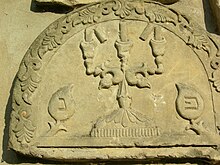
Tombstone of a Jewish woman depicting broken candles, a visual metaphor of the finish of life.
Metaphors can map experience between two nonlinguistic realms. Musicologist Leonard B. Meyer demonstrated how purely rhythmic and harmonic events can limited human emotions.[36] It is an open up question whether synesthesia experiences are a sensory version of metaphor, the "source" domain existence the presented stimulus, such equally a musical tone, and the target domain, being the experience in another modality, such as color.[37]
Art theorist Robert Vischer argued that when we expect at a painting, we "feel ourselves into it" past imagining our trunk in the posture of a nonhuman or inanimate object in the painting. For example, the painting The Solitary Tree by Caspar David Friedrich shows a tree with contorted, barren limbs.[38] [39] Looking at the painting, we imagine our limbs in a similarly contorted and arid shape, evoking a feeling of strain and distress. Nonlinguistic metaphors may exist the foundation of our experience of visual and musical art, likewise every bit trip the light fantastic toe and other art forms.[forty] [41]
In historical linguistics [edit]
In historical onomasiology or in historical linguistics, a metaphor is defined as a semantic change based on a similarity in form or function between the original concept and the target concept named by a give-and-take.[42]
For case, mouse: small, gray rodent with a long tail → small, grayness computer device with a long cord.
Some recent linguistic theories view all language in essence as metaphorical.[43]
Historical theories [edit]
Friedrich Nietzsche makes metaphor the conceptual center of his early theory of society in On Truth and Lies in the Non-Moral Sense.[44] Some sociologists have found his essay useful for thinking about metaphors used in society and for reflecting on their ain apply of metaphor. Sociologists of organized religion notation the importance of metaphor in religious worldviews, and that information technology is impossible to call up sociologically near organized religion without metaphor.[45]
See also [edit]
- Ingemination
- Camel's nose
- Colemanballs
- Conceptual blending
- Description
- Experience model
- Hypocatastasis
- Ideasthesia
- Listing of English-language metaphors
- Literal and figurative linguistic communication
- Metaphor identification procedure
- Metaphor in philosophy
- Metonymy
- Misnomer
- Origin of linguistic communication
- Origin of speech
- Pataphor
- Personification
- Reification (fallacy)
- Sarcasm
- Simile
- Synecdoche
- Analogy
- Tertium comparationis
- State of war as metaphor
- Globe Hypotheses
Notes [edit]
- ^ "In sum, there are now numerous results from comprehension-oriented studies suggesting that (1) comprehending metaphorical language activates concrete source domain concepts, and that (two) activating detail concrete perceptual or motor knowledge affects subsequent reasoning and language comprehension well-nigh a metaphorically continued abstract domain"[31]
References [edit]
Citations [edit]
- ^ Compare: "Definition of METAPHOR". www.merriam-webster.com . Retrieved 29 March 2016.
[...] a figure of voice communication in which a discussion or phrase literally cogent one kind of object or idea is used in place of another to suggest a likeness or analogy between them [... .]
- ^ The Oxford Companion to The English Linguistic communication, 2nd Edition (e-book). Oxford University Printing. 2018. ISBN978-0-xix-107387-8.
- ^ "As Y'all Similar Information technology: Unabridged Play". Shakespeare.mit.edu. Retrieved 4 March 2012.
- ^ "The last shot at American Idioms". 4 September 2019.
- ^ "Radio 4 – Reith Lectures 2003 – The Emerging Mind". BBC. Retrieved iv March 2012.
- ^ μεταφορά, Henry George Liddell, Robert Scott, A Greek-English Dictionary, on Perseus.
- ^ cdasc3D%2367010 μεταφέρω, Henry George Liddell, Robert Scott, A Greek-English Lexicon, on Perseus.
- ^ μετά, Henry George Liddell, Robert Scott, A Greek-English Lexicon, on Perseus.
- ^ φέρω, Henry George Liddell, Robert Scott, A Greek-English language Lexicon, on Perseus.
- ^ a b Jaynes, Julian (2000) [1976]. The Origin of Consciousness in the Breakdown of the Bicameral Heed (PDF). Houghton Mifflin. ISBN0-618-05707-ii.
- ^ Pierce, Dann Fifty. (2003). "Chapter Five". Rhetorical Criticism and Theory in Practise. McGraw-Hill. ISBN9780072500875.
- ^ The Oxford Companion to the English language Linguistic communication (1992) pp.653
- ^ The Columbia Encyclopedia (6th edition)
- ^ "Definition of ANTITHESIS".
- ^ "Definition of HYPERBOLE".
- ^ Adolf Jülicher, Die Gleichnisreden Jesu, second ed (Tübingen: J. C. B. Mohr, 1910).
- ^ "Definition of METONYMY".
- ^ a b Zuckermann, Ghil'ad (2020). Revivalistics: From the Genesis of Israeli to Language Reclamation in Australia and Beyond. New York: Oxford University Printing. ISBN9780199812790.
- ^ Working with the metaphor of life and decease
- ^ "Zapp Brannigan (Character)". IMDb . Retrieved 21 September 2014.
- ^ M. H. Abrams and Geoffrey Galt Harpham, A Glossary of Literary Terms, 11th ed. (Stamford, CT: Cengage Learning, 2015), 134.
- ^ Aristotle, W. Rhys Roberts, Ingram Bywater, and Friedrich Solmsen. Rhetoric. New York: Modern Library, 1954. Print.
- ^ Garret, Jan. "Aristotle on Metaphor." , Excerpts from Poetics and Rhetoric. N.p., 28 March 2007. Spider web. 29 Sept. 2014.
- ^ Moran, Richard. 1996. Bamboozlement and persuasion: The piece of work of metaphor in the rhetoric. In Essays on Aristotle'due south rhetoric, ed. Amelie Oksenberg Rorty, 385–398. Berkeley: University of California Press.
- ^ Ortony, Andrew (Winter 1975). "Why metaphors are necessary and non just overnice". Educational Theory. 25 (i): 45–53. doi:10.1111/j.1741-5446.1975.tb00666.ten.
- ^ "Cutting". Sylvia Plath Forum. Retrieved 4 March 2012.
- ^ http://www.sylviaplathforum.com/index.shtml Archived 12 September 2010 at the Wayback Auto
- ^ "1. The Road Not Taken. Frost, Robert. 1920. Mountain Interval". Bartleby.com. Retrieved 4 March 2012.
- ^ Foss, Sonja K. (1988). Rhetorical Criticism: Exploration and Do (4 ed.). Long Grove, Illinois: Waveland Press (published 2009). p. 249. ISBN9781577665861 . Retrieved 4 Oct 2018.
- ^ Lakoff, G. & Johnson, M. Metaphors Nosotros Alive By (IL: University of Chicago Press, 1980), Chapters 1–3. (pp. iii–13).
- ^ Sato, Manami; Schafer, Amy J.; Bergen, Benjamin K. (2015). "Metaphor priming in sentence production: Concrete pictures touch on abstract language product". Acta Psychologica. 156: 136–142. doi:10.1016/j.actpsy.2014.09.010. ISSN 0001-6918. PMID 25443987.
- ^ Lakoff G.; Johnson Thousand. (2003) [1980]. Metaphors We Live By. Chicago: University of Chicago Press. ISBN978-0-226-46801-3.
- ^ a b Zoltán Kövecses. (2002) Metaphor: a practical introduction. Oxford University Press US. ISBN 978-0-19-514511-3.
- ^ McKinnon, AM. (2013). 'Ideology and the Market Metaphor in Rational Pick Theory of Religion: A Rhetorical Critique of "Religious Economies"'. Critical Sociology, vol 39, no. 4, pp. 529-543.[i]
- ^ Meier, Brian P.; et al. (September 2007). "Failing to take the moral high ground: Psychopathy and the vertical representation of morality". Personality and Individual Differences. 43 (4): 757–767. doi:10.1016/j.paid.2007.02.001. Retrieved 1 November 2016.
- ^ Meyer, 50. (1956) Emotion and Meaning in Music. Chicago: University of Chicago Press
- ^ Blechner, M. (2018) The Mindbrain and Dreams: An Exploration of Dreaming, Thinking, and Artistic Creation. NY: Routledge
- ^ Blechner, M. (1988) Differentiating empathy from therapeutic activeness. Contemporary Psychoanalysis, 24:301–310.
- ^ Vischer, R. (1873) Über das optische Formgefühl: Ein Beitrag zur Aesthetik. Leipzig: Hermann Credner. For an English translation of selections, see Air current, Eastward. (1963) Art and Chaos. London: Faber and Faber.
- ^ Johnson, Yard. & Larson, South. (2003) "Something in the fashion she moves" – Metaphors of musical motion. Metaphor and Symbol, eighteen:63–84
- ^ Whittock, T. (1992) The function of metaphor in dance. British Journal of Aesthetics, 32:242–249.
- ^ Cf. Joachim Grzega (2004), Bezeichnungswandel: Wie, Warum, Wozu? Ein Beitrag zur englischen und allgemeinen Onomasiologie, Heidelberg: Winter, and Blank, Andreas (1997), Prinzipien des lexikalischen Bedeutungswandels am Beispiel der romanischen Sprachen, Tübingen: Niemeyer.
- ^ "Radio iv – Reith Lectures 2003 – The Emerging Mind". BBC. Retrieved iv March 2012.
- ^ "T he Nietzsche Channel: On Truth and Prevarication in an Extra-Moral Sense". oregonstate.edu.
- ^ McKinnon, A. Grand. (2012). "Metaphors in and for the Folklore of Religion: Towards a Theory afterward Nietzsche" (PDF). Periodical of Gimmicky Religion. pp. 203–216.
Sources [edit]
- This article incorporates material from the Citizendium commodity "Metaphor", which is licensed nether the Creative Eatables Attribution-ShareAlike three.0 Unported License only non under the GFDL.
- Stefano Arduini (2007). (ed.) Metaphors, Roma, Edizioni di Storia eastward Letteratura.
- Aristotle. Poetics. Trans. I. Bywater. In The Complete Works of Aristotle: The Revised Oxford Translation. (1984). 2 Vols. Ed. Jonathan Barnes. Princeton, NJ: Princeton University Printing.
- Max Black (1954). Metaphor, Proceedings of the Aristotelian Lodge, 55, pp. 273–294.
- Max Black (1962). Models and metaphors: Studies in language and philosophy, Ithaca: Cornell Academy Press.
- Max Black (1979). More near Metaphor, in A. Ortony (ed) Metaphor & Thought.
- Clive Cazeaux (2007). Metaphor and Continental Philosophy: From Kant to Derrida. New York, NY: Routledge.
- L. J. Cohen (1979). The Semantics of Metaphor, in A. Ortony (ed.), Metaphor & Thought.
- Donald Davidson. (1978). "What Metaphors Mean." Reprinted in Inquiries into Truth and Estimation. (1984). Oxford, England: Oxford University Press.
- Jacques Derrida (1982). "White Mythology: Metaphor in the Text of Philosophy." In Margins of Philosophy. Trans. Alan Bass. Chicago, University of Chicago Printing.
- René Dirvens; Ralf Pörings, eds. (2002). Metaphor and Metonymy in Contrast. Berlin.: Mouton de Gruyter.
- Fass, Dan (1988). "Metonymy and metaphor: what'south the divergence?". Proceedings of the 12th conference on Computational linguistics. Vol. 1. pp. 177–81. doi:10.3115/991635.991671. ISBN978-963-8431-56-i. S2CID 9557558.
- Jakobson, Roman (1990). "Ii Aspects of Linguistic communication and Two Types of Aphasic Disturbances". In Linda Waugh; Monique Monville-Burston (eds.). On Language. Cambridge, MA: Harvard University Press. pp. 115–133. ISBN978-0-674-63536-4.
- Lakoff, Chiliad. & Johnson, M. Metaphors We Live Past (IL: University of Chicago Printing, 1980), Chapters 1–3. (pp. 3–13).
- Lakoff, George (1980). Metaphors We Live By. Chicago, IL: The University of Chicago Press. ISBN978-0-226-46801-3. .
- Depression, Graham (11 February 1999). "An Essay is a Person". In Cameron, Lynne; Low, Graham (eds.). Researching and Applying Metaphor. Cambridge, England: Cambridge University Printing. pp. 221–48. ISBN978-0-521-64964-3.
- Peters, Wim (2003). "Metonymy as a cross-lingual miracle". Proceedings of the ACL 2003 workshop on Lexicon and figurative linguistic communication. Vol. 14. pp. 1–9. doi:10.3115/1118975.1118976. S2CID 8267864.
- McKinnon, AM. (2012). 'Metaphors in and for the Sociology of Religion: Towards a Theory later Nietzsche'. Periodical of Contemporary Faith, vol 27, no. two, pp. 203–216. [two]
- David Punter (2007). Metaphor, London, Routledge.
- Paul Ricoeur (1975). The Dominion of Metaphor: Multi-Disciplinary Studies in the Creation of Meaning in Linguistic communication, trans. Robert Czerny with Kathleen McLaughlin and John Costello, S. J., London: Routledge and Kegan Paul 1978. (Toronto: University of Toronto Printing 1977)
- I. A. Richards. (1936). The Philosophy of Rhetoric. Oxford, Oxford University Printing.
- John Searle (1979). "Metaphor," in A. Ortony (ed.) Metaphor and Idea, Cambridge University Press.
- Underhill, James W., Creating Worldviews: Metaphor, Ideology & Language, Edinburgh UP, 2011.
- Herscberger, Ruth (Summer 1943). "The Structure of Metaphor". The Kenyan Review. v (3): 433–443. JSTOR 4332426.
- Rudmin, Floyd W. (1991). "Having: A Brief History of Metaphor and Meaning". Syracuse Law Review. 42: 163. Retrieved xi October 2013.
- Somov, Georgij Yu (2013). "The interrelation of metaphors and metonymies in sign systems of visual art: An example assay of works by V. I. Surikov". Semiotica. 2013 (193): 31–66. doi:10.1515/sem-2013-0003.
External links [edit]
 | Look up metaphor in Wiktionary, the free dictionary. |
 | Wikiquote has quotations related to Metaphors . |
 | Wikimedia Eatables has media related to Metaphors. |
- History of metaphor on In Our Fourth dimension at the BBC
- A brusque history of metaphor
- Sound illustrations of metaphor as figure of speech communication
- Top Ten Metaphors of 2008
- Shakespeare's Metaphors
- Definition and Examples
- Metaphor Examples (categorized)
- Listing of ancient Greek words starting with μετα-, on Perseus
- Metaphor and Phenomenology article in the Cyberspace Encyclopedia of Philosophy
- Metaphors algebra
- Pérez-Sobrino, Paula (2014). "Meaning construction in verbomusical environments: Conceptual disintegration and metonymy" (PDF). Periodical of Pragmatics. lxx: 130–151. doi:10.1016/j.pragma.2014.06.008.
williamslabon1937.blogspot.com
Source: https://en.wikipedia.org/wiki/Metaphor
0 Response to "What Number Is Used Again and Again in the Construction and Design of Paths Metaphors"
Post a Comment